
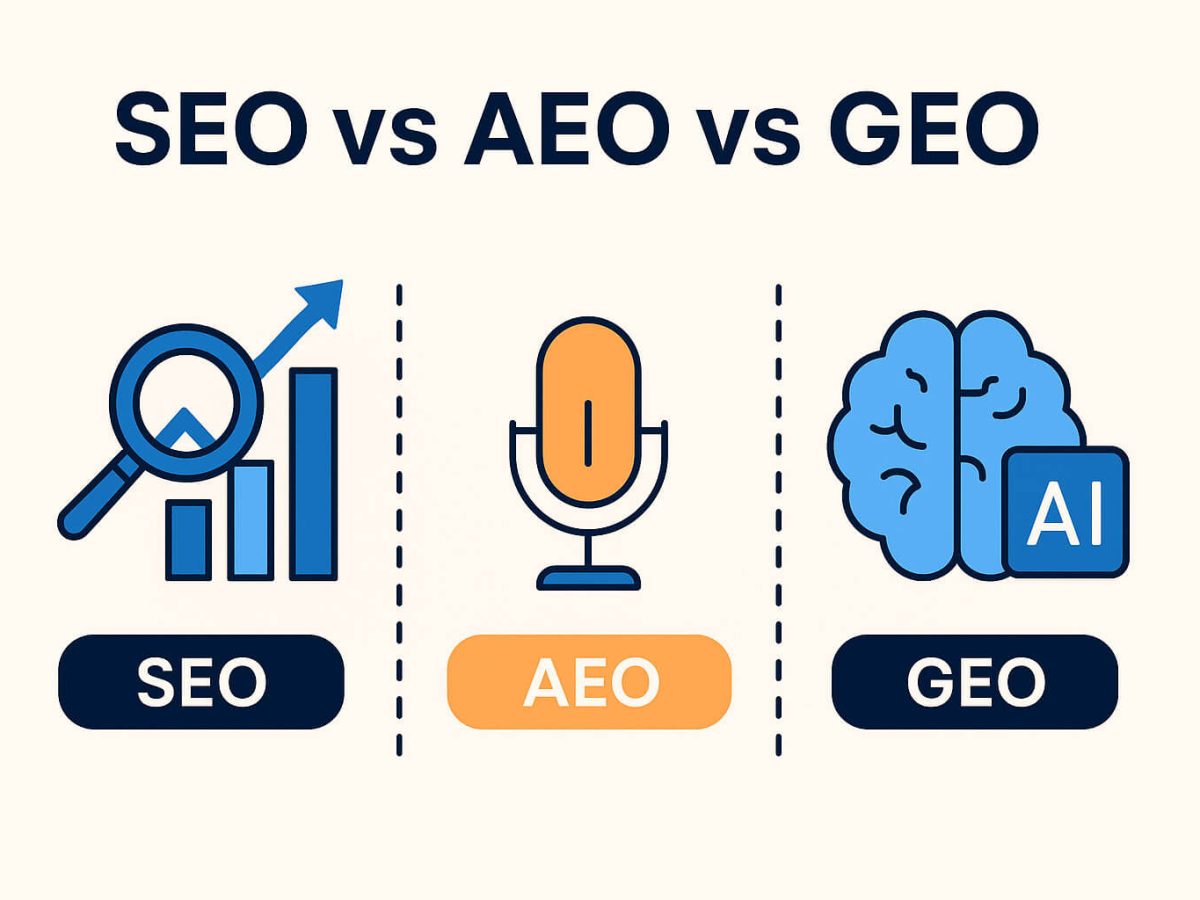
The digital world is changing faster than ever. What worked in SEO five years ago now feels outdated. Search engines are evolving, and artificial intelligence is reshaping how content is discovered, ranked, and displayed. As we move toward 2026, three major forces define the future of online visibility — SEO, GEO, and AEO.
Each one plays a critical role in how brands, creators, and businesses appear in search results and AI-driven recommendations. Understanding how these three interact will help you stay ahead of competitors and prepare for the next phase of digital marketing.
1. What Is SEO in 2026?
Search Engine Optimization (SEO) has always been about improving your website’s visibility on search engines like Google, Bing, and Yahoo. However, in 2026, SEO is more human and AI-driven than ever before.
1.1. AI and Human Intent
Google’s algorithms are now designed to deeply understand intent, not just keywords. This means SEO professionals must optimize content around how people think, feel, and search. Artificial Intelligence tools like ChatGPT, Gemini, and Perplexity AI are changing how search happens — and in many cases, AI generates the answers directly.
Therefore, SEO strategies now go beyond keywords. They focus on topic clusters, search journeys, and contextual optimization.
1.2. User Experience is the Core
In the new SEO era, websites that offer smooth navigation, fast loading times, and interactive designs outperform others. Core Web Vitals, mobile-first indexing, and AI-generated summaries all favor sites that prioritize the user.
Furthermore, Google’s Search Generative Experience (SGE) pulls information from well-structured sites. So, a clear hierarchy, schema markup, and concise formatting are essential.
2. GEO: Generative Engine Optimization
Generative Engine Optimization (GEO) is the next big leap after SEO. It focuses on optimizing content for AI-powered search engines, such as ChatGPT, Gemini, and other LLM-based tools.
2.1. Why GEO Matters
Traditional SEO aims to rank on Google’s Search Engine Results Page (SERP). But GEO ensures your brand is mentioned, cited, and sourced when AI tools generate answers.
For example, when a user asks ChatGPT, “What’s the best SEO agency in India?”, GEO ensures your brand appears as part of the AI’s response — not just on a Google link. This is powerful because AI search bypasses traditional clicks and delivers summarized, conversational answers.
2.2. How to Optimize for GEO
To perform well in GEO:
- Create authoritative content that answers questions clearly.
- Use structured data (schema markup) to help AI understand your pages.
- Focus on credibility by gaining mentions on trusted sites.
- Publish research-backed insights and statistics.
- Include your brand name naturally within educational or informative content.
Moreover, content must be written in a way that AI can easily cite. This means well-labeled headings, concise explanations, and natural keyword flow.
2.3. GEO vs SEO: The Key Difference
SEO optimizes for ranking positions. GEO optimizes for AI visibility — the ability to be referenced, quoted, or recommended by generative search systems.
In other words:
SEO gets you seen on Google.
GEO gets you mentioned by AI.
3. AEO: Answer Engine Optimization
Answer Engine Optimization (AEO) is about optimizing for voice assistants, smart devices, and AI-driven answer boxes. Tools like Alexa, Siri, and Google Assistant rely on structured and concise content to provide direct answers.
3.1. How AEO Works
When a user asks, “What’s the best digital marketing agency near me?”, the AI assistant pulls data from trusted sources. If your content is optimized for voice and featured snippets, your brand could be the answer.
AEO prioritizes brevity, structure, and conversational tone. It relies heavily on schema, Q&A formats, and NLP-friendly content.
3.2. Tips for AEO Optimization
To optimize for AEO:
- Use FAQ sections on every key page.
- Add schema markup (FAQPage, LocalBusiness, HowTo).
- Write in natural, conversational language.
- Provide direct answers to common questions.
- Optimize for voice search using long-tail keywords and intent-based phrasing.
Therefore, AEO isn’t just about being found — it’s about being the answer.
4. The Convergence of SEO, GEO, and AEO
By 2026, the lines between SEO, GEO, and AEO are fading. Businesses must integrate all three to maintain strong online visibility.
4.1. Unified Strategy
- SEO ensures discoverability on traditional search engines.
- GEO ensures visibility within AI-generated results.
- AEO ensures you appear in instant answers and voice results.
Together, these systems form a tri-layered optimization approach. A strong online presence now means optimizing across all three dimensions.
4.2. The Role of AI Tools
AI tools such as ChatGPT, Jasper, and SurferSEO help automate keyword research, content briefs, and optimization. They also assist in analyzing user behavior, generating meta descriptions, and identifying content gaps.
Additionally, AI analytics platforms can track how often your brand appears in AI responses — a new metric known as Generative Visibility Rate (GVR).
5. Why Brands Must Evolve Now
If your digital strategy only focuses on SEO, you’re missing a major opportunity. GEO and AEO are shaping how searchers discover content — and most businesses haven’t yet adapted.
5.1. Shift from Clicks to Mentions
Search traffic is no longer the only indicator of success. In AI-driven search, brand mentions and citation authority matter more than backlinks. Therefore, investing in GEO-based optimization early gives you a head start.
5.2. Data-Driven Personalization
AI marketing tools enable personalized user journeys — from email automation to content delivery. Integrating SEO, GEO, and AEO data ensures every touchpoint feels personal, relevant, and timely.
5.3. Human + AI Collaboration
While AI handles large-scale optimization and analytics, human creativity ensures storytelling, emotion, and trust. The future belongs to brands that combine both effectively.
6. How Averis Digital Leads the Future
At AverisDigital.com, we help businesses adapt to this new AI-powered search ecosystem. Our approach blends traditional SEO, GEO strategies, and AEO optimization — ensuring your brand stays visible everywhere.
We also integrate:
- AI-based keyword research
- Schema and data optimization
- Voice and generative engine visibility tracking
- Performance analytics and brand monitoring
Follow us on Instagram for updates and insights:
👉 @AverisDigital
7. Quick Answers: SEO, GEO & AEO Essentials
Why is SEO still important?
It builds trust and long-term visibility through quality content and backlinks.
What is GEO in simple terms?
GEO ensures your brand appears in AI-generated results and conversations.
Why is AEO vital for 2026?
It helps you become the top answer for voice and AI search queries.
Can these three work together?
Yes. A unified SEO-GEO-AEO strategy ensures consistent visibility across all search and AI platforms.
Conclusion
The era of static SEO is over. We’re entering a dynamic phase where visibility means adaptability — across search engines, AI tools, and digital assistants.
By understanding and implementing SEO, GEO, and AEO together, brands can future-proof their presence, stay discoverable in AI-driven environments, and lead the competition into 2026 and beyond.
Start optimizing today — because the search of tomorrow has already begun.

One Reply on “The Future of Online Visibility: SEO vs GEO vs AEO (2026 Edition)”
Comments are closed.