
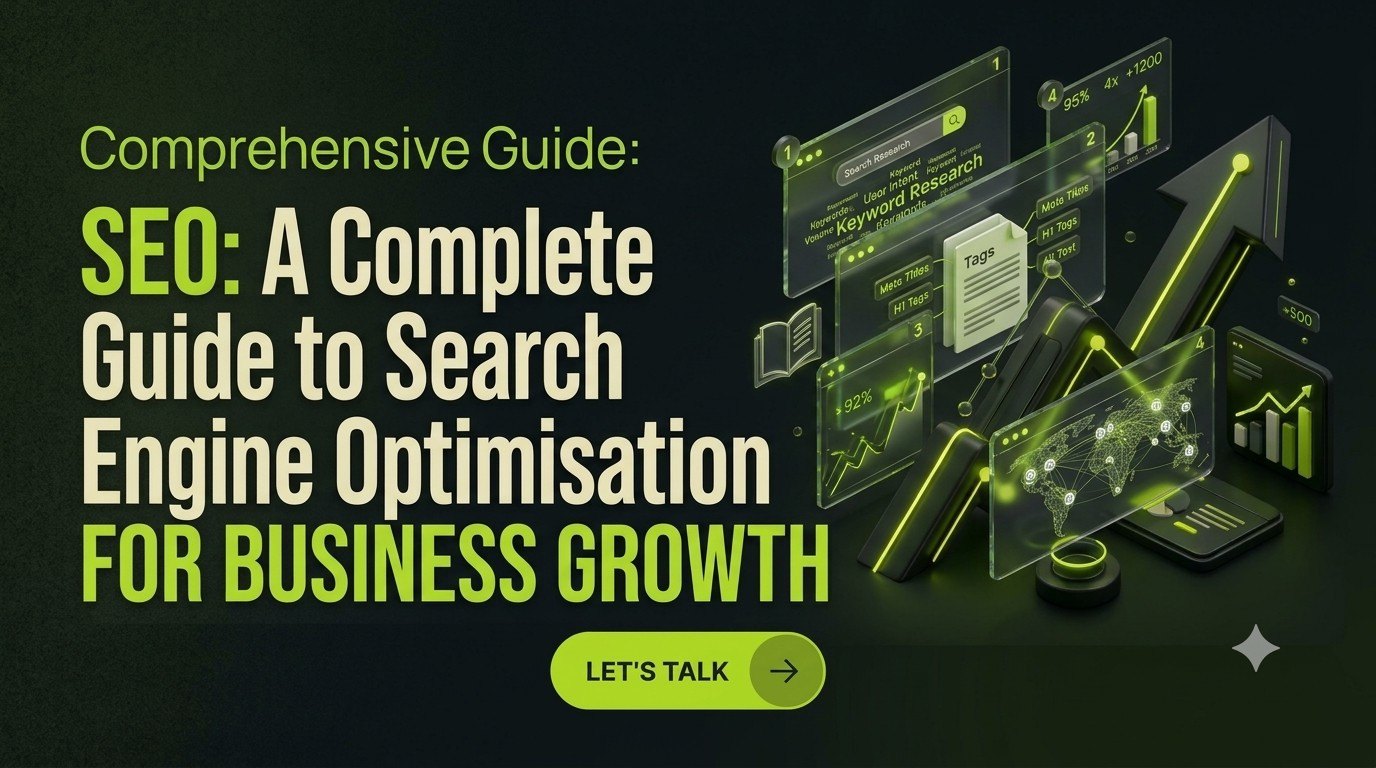
Having a professional website is important for every modern business. However, simply creating a website does not guarantee visitors, customer enquiries, or online sales. Your potential customers use search engines like Google to find products, services, and solutions every day. Therefore, SEO (Search Engine Optimization) plays an important role in improving your website’s visibility in relevant search results, attracting organic traffic, and reaching the right audience.
This is where SEO (Search Engine Optimisation) becomes important. SEO is the process of improving a website so that it can appear more prominently in organic search results. It helps search engines understand your website while making it easier for potential customers to find relevant information.
Whether you run a small business, startup, e-commerce store, or established company, SEO can help you build a stronger online presence. Moreover, a well-planned SEO strategy can attract visitors who are already searching for products or services like yours.
However, SEO is much more than adding keywords to website content. It includes keyword research, technical improvements, content optimisation, website structure, internal linking, and building online authority.
In this guide, we will explain what SEO is, how it works, why it matters, and which strategies businesses can use to improve their Google visibility and achieve long-term online growth.
What Is SEO?
SEO stands for Search Engine Optimisation. It refers to the process of improving a website’s visibility in search engines such as Google and Bing.
When someone searches for a product, service, or answer, search engines display relevant web pages. SEO helps your website become easier to discover, understand, and evaluate for relevant searches.
For example, imagine you own a digital marketing company. Potential customers may search for:
- SEO Services in India
- Best SEO Company in Delhi
- SEO Expert for Small Business
- Local SEO Services
- Shopify SEO Agency
- Website SEO Consultant
If your website contains useful information and is properly optimised for relevant search queries, it may have a better opportunity to appear in search results.
However, search rankings depend on many factors, including content relevance, website quality, competition, technical performance, and the overall usefulness of a page.
SEO does not guarantee a particular ranking. Instead, it focuses on improving the factors that help search engines understand and present your website.
Why Is SEO Important for Businesses?
Today, customers often search online before choosing a company, comparing products, or purchasing a service. Therefore, businesses need a strong digital presence to reach potential customers.
SEO can support this goal in several ways.
1. Increase Organic Website Traffic
Organic traffic refers to visitors who reach your website through unpaid search engine results.
Unlike paid advertising, organic search traffic does not require you to pay for every click. However, SEO still requires investment in content, technical improvements, tools, and professional services.
When your website ranks for relevant keywords, it can attract visitors who are actively looking for your products or services.
For example, a company selling office furniture may target searches related to office chairs, workstations, and office desks. As a result, its website can reach people who are already interested in those products.
2. Improve Google Search Visibility
Your website needs to appear where potential customers are searching.
SEO helps improve your visibility by optimising important website pages around relevant search queries.
For example, a website development company may create separate pages for WordPress development, Shopify development, and e-commerce website design.
This approach allows each page to target a specific service and customer requirement.
3. Generate Quality Business Leads
More website traffic does not always mean more business. The quality and relevance of visitors are equally important.
SEO helps attract users who are searching for specific products, services, or solutions.
Moreover, optimised landing pages can encourage visitors to take action through:
- Contact forms
- Phone calls
- Email enquiries
- Product purchases
- Appointment bookings
- Quote requests
Therefore, businesses should focus on attracting relevant visitors rather than simply increasing traffic numbers.
4. Build Brand Awareness
Appearing in relevant search results can help more people discover your business.
Even when users do not immediately contact you, repeated visibility can improve brand recognition over time.
Furthermore, useful blog articles, service pages, and guides can position your business as a helpful source of information within your industry.
5. Support Long-Term Business Growth
SEO is a long-term marketing strategy. Although it takes time to build visibility, well-optimised pages can continue attracting visitors after publication.
However, maintaining performance requires regular content updates, technical monitoring, and improvements based on search trends.
Consequently, SEO can become an important part of a sustainable digital marketing strategy.
How Does SEO Work?
Search engines use automated systems to discover, understand, and organise website content. Google generally describes this process through three main stages: crawling, indexing, and serving search results.
Understanding these stages helps businesses build websites that search engines can access and interpret.
1. Crawling
Search engines use automated programs, often called crawlers or bots, to discover web pages.
These crawlers follow links and explore website content to find new or updated pages.
Therefore, your website should have a clear structure, working internal links, and accessible important pages.
2. Indexing
After discovering a page, a search engine may analyse its content and store information about it in its index.
However, discovering a page does not guarantee that it will be indexed.
Duplicate content, technical problems, poor accessibility, and other factors can affect indexing.
Businesses should use Google Search Console to monitor important indexing issues.
3. Ranking and Search Results
When someone searches for a query, search engines use automated systems to select and display relevant results.
They consider many signals to understand which pages may be useful for the search.
These can include relevance, content quality, usability, page experience, and other factors.
Therefore, SEO requires a complete approach rather than relying on a single ranking technique.
Main Types of SEO
SEO includes several areas of website optimisation. Each area focuses on a different part of your website’s search performance.
1. On-Page SEO
On-page SEO involves optimising individual website pages to improve their relevance and usability.
It helps search engines understand the subject of a page while making the content easier for visitors to read.
Important on-page SEO activities include:
- Keyword placement
- SEO title optimisation
- Meta description writing
- Heading structure
- Content improvement
- Image alt text
- Internal linking
- URL optimisation
- Relevant page formatting
For example, if your target keyword is “SEO Services in India”, your service page should explain the services clearly and use the keyword naturally.
However, avoid repeating the same phrase unnecessarily. Content should always be written for people first.
2. Off-Page SEO
Off-page SEO refers to activities outside your website that can support its visibility and reputation.
Backlinks are an important part of this area. A backlink is a link from another website pointing to your website.
Relevant and trustworthy backlinks can help search engines understand how your website is connected to other online resources.
Off-page SEO activities may include:
- Digital PR
- Relevant guest contributions
- Industry partnerships
- Genuine business directories
- Brand mentions
- Useful resource promotion
- Relevant editorial links
However, buying large quantities of spammy backlinks can create risks. Focus on relevance, quality, and genuine online relationships.
3. Technical SEO
Technical SEO focuses on the technical structure and performance of your website.
Even useful content may struggle to perform if important pages cannot be crawled or indexed properly.
Technical SEO activities include:
- Website speed improvements
- Mobile-friendly design
- HTTPS security
- XML sitemap configuration
- Robots.txt review
- Canonical tag implementation
- Broken link identification
- Redirect management
- Structured data
- Core Web Vitals monitoring
Furthermore, technical SEO should be reviewed regularly because website updates, plugins, themes, and development changes can introduce new issues.
4. Local SEO
Local SEO helps businesses improve their visibility for searches connected to specific locations.
It is particularly useful for service providers, shops, restaurants, clinics, and other businesses serving local customers.
For example, a business operating in Gurgaon may want to reach people searching for digital marketing services in Gurgaon or nearby areas.
Local SEO activities include:
- Google Business Profile optimisation
- Local keyword research
- Business contact information consistency
- Location-specific website pages
- Customer review management
- Local citations
- Relevant local content
As a result, local SEO can help businesses reach customers who are searching for nearby products and services.
5. E-commerce SEO
E-commerce SEO focuses on improving the organic visibility of online stores.
Unlike a standard business website, an e-commerce website may contain hundreds or thousands of product and category pages.
Therefore, it needs a structured optimisation strategy.
Important e-commerce SEO activities include:
- Product title optimisation
- Product description writing
- Category page optimisation
- Image optimisation
- Product structured data
- Internal linking
- Duplicate URL management
- Faceted navigation review
- Technical SEO audits
Shopify and WooCommerce stores can both benefit from a properly planned e-commerce SEO strategy.
Important SEO Ranking Factors to Understand
Google uses many systems and signals to determine which pages appear in search results. No single factor guarantees a high ranking.
However, businesses should pay attention to several important areas.
Helpful and Relevant Content
Your website content should answer customer questions and provide useful information.
For example, a page about website development should explain the service, process, benefits, and relevant business considerations.
Avoid publishing content only to increase the number of pages on your website.
Search Intent
Search intent refers to the reason behind a user’s search.
For example:
| Search Query | Search Intent | Suitable Content |
|---|---|---|
| What is SEO? | Informational | Educational blog |
| SEO Services India | Commercial | SEO service page |
| Best SEO Company | Commercial | Service comparison page |
| Hire SEO Expert | Transactional | Contact or service page |
| SEO Pricing | Commercial | Pricing guide |
Understanding search intent helps you create the right type of content for each keyword.
Mobile-Friendly Experience
Many users access websites through smartphones.
Therefore, your website should have a responsive design, readable text, easy navigation, and properly displayed images.
A difficult mobile experience can discourage visitors from exploring your website.
Website Performance
Page loading and visual stability are important parts of the user experience.
Google’s Core Web Vitals provide measurements related to loading performance, interactivity, and visual stability.
Businesses should monitor these metrics and improve issues where practical.
Website Security
A secure website helps protect visitors and supports trust.
Using HTTPS is an important basic requirement for modern websites.
Additionally, businesses should maintain updated software, themes, plugins, and security settings.
SEO vs Paid Advertising: What Is the Difference?
SEO and paid advertising are both useful digital marketing methods. However, they work differently and support different business goals.
| Comparison | SEO | Paid Advertising |
|---|---|---|
| Traffic source | Organic search results | Sponsored advertisements |
| Payment model | Investment in SEO work and resources | Usually based on clicks, impressions, or campaign objectives |
| Time to results | Generally takes time | Can generate visibility quickly |
| Long-term value | Pages may continue attracting traffic | Traffic usually depends on active campaigns |
| Keyword targeting | Based on organic search opportunities | Based on campaign targeting and bidding |
| Best use | Long-term organic visibility | Immediate campaign reach and testing |
Many businesses use both methods together.
For example, paid advertising can help test landing pages and offers, while SEO can build long-term organic visibility.
The right balance depends on your budget, competition, business model, and growth objectives.
Step-by-Step SEO Strategy for Business Websites
A successful SEO campaign should follow a structured process. Random changes and keyword placement alone are unlikely to create sustainable results.
Here is a practical approach.
Step 1: Conduct a Website SEO Audit
Start by understanding the current condition of your website.
Review technical problems, indexing status, content quality, website structure, page speed, and existing keyword performance.
Tools such as Google Search Console, Google Analytics, and website crawling software can help identify opportunities.
Step 2: Perform Keyword Research
Identify what your potential customers search for online.
Choose keywords according to:
- Search relevance
- Search intent
- Competition
- Search volume
- Business value
- Conversion potential
Additionally, organise keywords according to website pages to avoid unnecessary keyword overlap.
Step 3: Optimise Important Website Pages
Review your homepage, service pages, category pages, and product pages.
Make sure every important page has a clear purpose and provides useful information.
Optimise titles, headings, content, images, and internal links.
Step 4: Create Useful SEO Content
Publish blog articles and guides that answer real customer questions.
For example, a digital marketing company can publish content about SEO basics, local SEO, website optimisation, e-commerce SEO, and keyword research.
Furthermore, connect relevant blog posts to your service pages through natural internal links.
Step 5: Improve Technical SEO
Fix important crawling, indexing, redirect, mobile usability, and performance issues.
However, prioritise problems according to their severity and impact rather than making unnecessary changes.
Step 6: Build Website Authority
Promote useful content and build genuine relationships with relevant websites and industry publications.
Focus on earning relevant backlinks instead of purchasing large quantities of low-quality links.
Step 7: Track Performance
SEO requires regular monitoring.
Use tools such as Google Search Console and Google Analytics to measure:
- Organic clicks
- Search impressions
- Click-through rate
- Average search position
- Organic landing page traffic
- Conversions
- Enquiries and sales
Finally, use the data to improve your strategy and focus on activities that support your business objectives.
Best SEO Tools for Website Optimisation
SEO tools help businesses research keywords, analyse websites, identify technical issues, and monitor performance.
Some commonly used tools include:
| SEO Tool | Main Purpose |
|---|---|
| Google Search Console | Search performance and indexing monitoring |
| Google Analytics | Website traffic and user behaviour |
| Google Keyword Planner | Keyword research and advertising estimates |
| Semrush | Keyword, competitor, and backlink research |
| Ahrefs | Backlink and keyword analysis |
| Screaming Frog SEO Spider | Website crawling and technical audits |
| PageSpeed Insights | Website performance analysis |
| Yoast SEO | WordPress content and on-page SEO guidance |
You do not need every tool to start SEO. A small business can begin with free tools such as Google Search Console, Google Analytics, and PageSpeed Insights.
As your website grows, paid tools may provide additional research and analysis features.
Common SEO Mistakes Businesses Should Avoid
Many websites struggle because of avoidable optimisation mistakes.
Understanding these problems can help you build a better SEO strategy.
1. Keyword Stuffing
Repeating the same keyword too many times makes content unnatural and difficult to read.
Instead, use your main keyword naturally and include related phrases where they make sense.
2. Ignoring Search Intent
A page may target a popular keyword but still fail to meet user expectations.
For example, someone searching for SEO pricing probably wants information about costs, packages, and deliverables rather than a general introduction to SEO.
Therefore, create content that matches what users are trying to find.
3. Publishing Duplicate Content
Copying content from other websites or publishing multiple pages with almost identical information provides limited value.
Create original content that reflects your services, experience, and audience requirements.
4. Ignoring Mobile Users
A website that is difficult to use on mobile devices can create a poor experience.
Check page layouts, navigation, buttons, forms, and text readability on different screen sizes.
5. Buying Spammy Backlinks
Low-quality link-building practices can create risks for your website.
Focus on relevant websites, useful content, and genuine promotional opportunities.
6. Not Tracking SEO Performance
Without performance data, it is difficult to understand which pages are working and where improvements are needed.
Review your organic search performance regularly and make decisions based on reliable data.
How Much Do SEO Services Cost in India?
SEO pricing depends on the website size, competition, business requirements, and amount of work involved.
A small local business may need a focused local SEO campaign, while a large e-commerce store may require technical optimisation, content development, and ongoing SEO support.
The following table shows illustrative pricing ranges. These are not fixed industry rates.
| SEO Service | Illustrative Price Range |
|---|---|
| Basic SEO Audit | ₹5,000–₹15,000 |
| Local SEO Services | ₹25,000–₹25,000 per month |
| Small Business SEO | ₹25,000–₹45,000 per month |
| Professional SEO Services | ₹25,000–₹90,000 per month |
| E-commerce SEO | ₹25,000–₹80,000+ per month |
| Enterprise SEO | Custom Pricing |
Before choosing an SEO package, check what is included.
A professional proposal should explain keyword research, technical improvements, content work, link-building activities, reporting, and expected responsibilities.
Most importantly, avoid choosing a provider only because they promise fast rankings at an unusually low price.
Why Choose AverisDigital for SEO Services?
AverisDigital helps businesses improve their digital presence through SEO, website development, and digital marketing services.
The goal is to create practical strategies that match each business’s website, target audience, competition, and growth objectives.
Whether you are a startup, small business, service provider, or e-commerce brand, a structured SEO approach can help improve your website’s organic search visibility.
Professional SEO Services
AverisDigital offers SEO-related services such as:
- Website SEO audits
- Keyword research
- On-page SEO
- Technical SEO
- Content optimisation
- Off-page SEO
- Local SEO
- WordPress SEO
- Shopify SEO
- SEO performance monitoring
WordPress and Shopify SEO
Your website platform and structure can influence the type of SEO work required.
For WordPress websites, optimisation may include page structure, metadata, website performance, internal linking, and content organisation.
Similarly, Shopify SEO may involve product pages, collection pages, structured data, duplicate URL management, and technical improvements.
Explore our Website Development Services to learn how a professionally developed website can support your online business.
SEO Strategies Based on Business Goals
Every business has different requirements. Therefore, SEO should be planned according to your industry, website condition, target customers, and competition.
AverisDigital focuses on identifying practical opportunities and creating an optimisation plan that supports your business objectives.
Learn more about our SEO Services and how professional website optimisation can support organic growth.
For more information about our digital marketing solutions, visit AverisDigital.com.
The Future of SEO
Search engines and online search behaviour continue to evolve. Businesses should therefore focus on useful content, strong website experiences, and accurate information.
AI and Search
AI-powered search experiences are changing how people discover information.
Businesses should focus on creating clear, original, and helpful content that answers customer questions.
However, using AI tools to produce content does not automatically improve rankings. Content quality, accuracy, usefulness, and originality remain important.
User Experience
A website should be easy to navigate, fast enough for visitors, and accessible across devices.
Therefore, businesses should regularly review their website design, page structure, forms, and navigation.
Local Search Growth
Local search remains important for businesses that serve customers in specific locations.
Accurate business details, useful location pages, and customer reviews can support local visibility.
Content Quality
Search engines aim to provide relevant information to users.
As a result, businesses should focus on creating useful guides, detailed service pages, and original content instead of publishing large amounts of repetitive material.
Conclusion
SEO is an important part of building a strong online presence. It helps businesses improve their search visibility, attract relevant organic traffic, and connect with potential customers.
However, successful SEO requires more than adding keywords to website pages. It involves keyword research, technical improvements, useful content, internal linking, website performance, and continuous monitoring.
Whether you operate a startup, local business, or e-commerce store, a well-planned SEO strategy can support your long-term digital marketing goals.
If you want to improve your Google visibility, attract relevant visitors, and generate more business enquiries, professional SEO support can help you identify the right opportunities.
Ready to grow your business with SEO?
Connect with AverisDigital to discuss your website and SEO requirements.
Contact AverisDigital:
- Website: https://averisdigital.com/
- Email: Namaste@AverisDigital.com
- Phone: +91 9910 368 366
- Instagram: https://www.instagram.com/AverisDigital/
Frequently Asked Questions (FAQs)
1. What is SEO in digital marketing?
SEO stands for Search Engine Optimisation. It is the process of improving a website to increase its visibility in organic search engine results. It includes keyword research, content optimisation, technical SEO, and link building.
2. Why is SEO important for a business website?
SEO helps businesses reach people who are actively searching for their products or services. It can improve organic visibility, attract relevant website traffic, support brand awareness, and generate potential customer enquiries.
3. How long does SEO take to show results?
SEO results depend on website history, competition, content quality, technical condition, and optimisation efforts. Some websites may notice improvements within a few months, while competitive projects can take longer. There is no guaranteed ranking timeline.
4. What are the main types of SEO?
The main types include on-page SEO, off-page SEO, technical SEO, local SEO, and e-commerce SEO. Each focuses on a different area of website optimisation and search visibility.
5. How much do SEO services cost in India?
SEO pricing varies according to website size, competition, services, and business goals. Small business SEO may start around ₹25,000 per month, while complex e-commerce and enterprise projects can require larger budgets. Always review the service scope before hiring.